Brand Archetypes Explained: How Personality Drives Differentiation
Personality drives differentiation, and brand archetypes drive personality. Learn what a brand archetype is and why it’s an essential brand asset.

Jackie Bebenroth, Muse Founder & Principal
A Brand Archetype Should Be Part of Your Marketing Team’s Toolkit
The brands that consumers can't stop thinking about aren't smarter than the competitors; they just have more personality.
Over the course of my career, I’ve seen how a bold tone, executed consistently, matters almost more than the messaging strategy itself! Enter: brand archetypes.
Key Takeaways:
- Archetypes are a strategic tool, not a creative label
- Emotional identity is a strong competitive differentiator
- The right archetype reflects how you operate, not just who you aspire to be
- Commitment is everything; winning brands act with discipline and courage to stay in character
- In the age of AI, your archetype helps teams stay on brand
In a landscape crowded with capable competitors making similar claims, the brands that endure often win on consistent identity and human connection. This is especially true for Gen Z. According to a Vogue Business and Archrival report, 57% of Gen Z respondents prefer brands that are unique and beloved by a tight-knit community.
Brand archetypes are frequently introduced as a tool for defining personality. Sure, that framing is accurate, but it dramatically undersells what archetypes can actually do. In the hands of a skilled strategist or creative team, an archetype becomes a living lens through which every campaign, design system, content strategy, and client conversation can be evaluated.
I love that archetypes help teams reframe questions from being subjective to strategic. When a client requests a change based on preference, we often ask, “Is this the kind of choice our archetype would make?”
So, What is a Brand Archetype?
A brand archetype is a recognizable character type that represents a brand's emotional identity. Each archetype carries core desires, fears, motivations, and behavioral traits. That psychological scaffolding is what gives the framework its strategic value. It moves a brand beyond surface-level adjectives like "trustworthy" or "innovative" into something more emotionally durable and creatively actionable. We dig into brand archetypes and why they’re powerful in our Brand Archetype Guide.
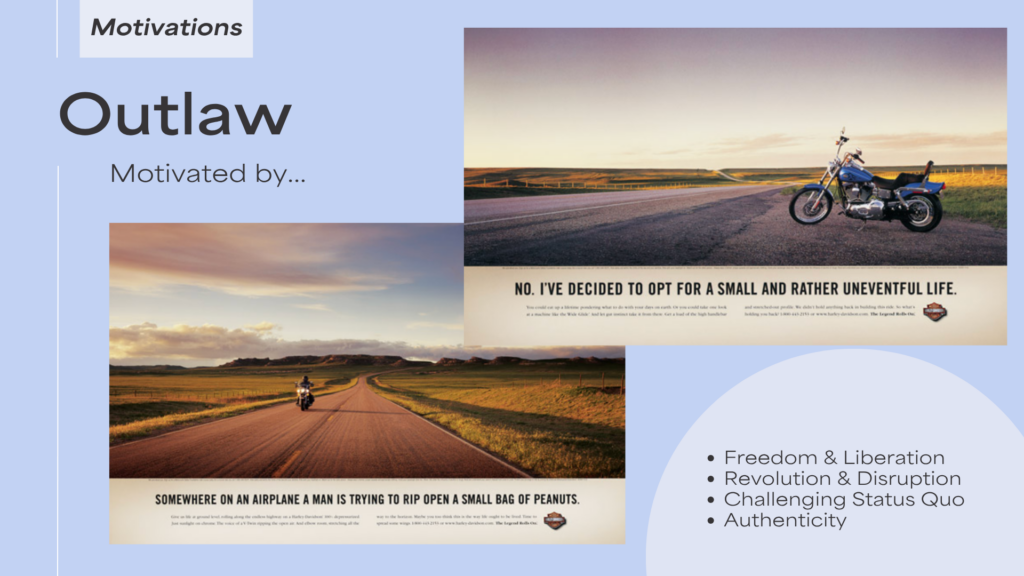
Harley-Davidson as the Outlaw is one of the most cited examples for good reason. The brand expresses this archetype not just through messaging, but through every creative decision: expansive open-road imagery, a spirit of rebellion, a persistent resistance to conformity. The motorcycle is never the whole story. The emotional promise is liberation, and this is the throughline that’s consistent thanks to the archetype anchor.
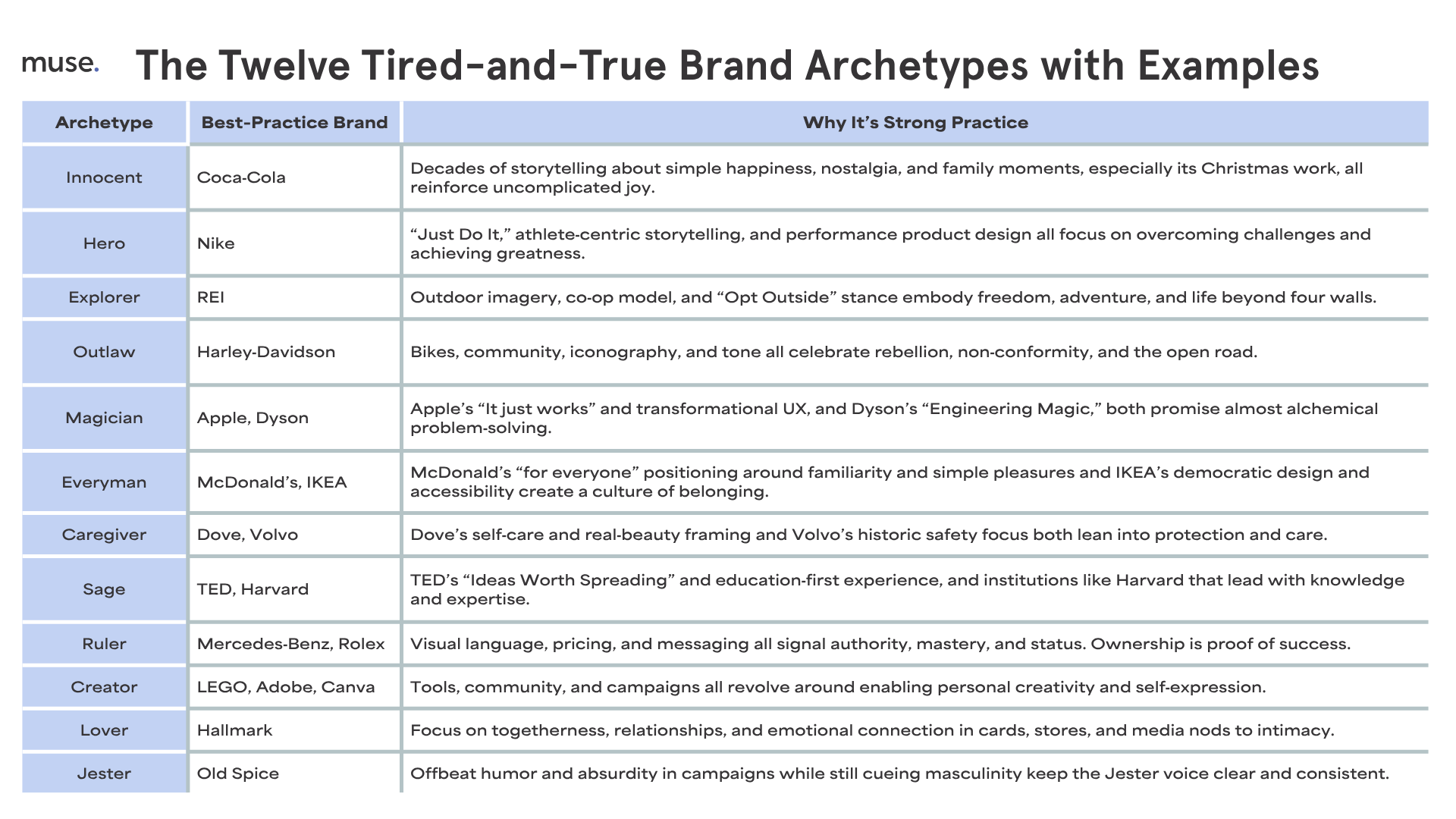
When your audience sees your brand and immediately feels something recognizable, that's not an accident.
The Sage educates and illuminates. The Caregiver nurtures and reassures. The Jester delights through irreverence. The Ruler leads with precision and control. Understanding which archetype reflects your brand's truest expression is essential, and it's why we build archetype selection into foundational brand work.
The Real Problem Archetypes Solve
Looking at how many of our clients communicated before we developed their brand archetype, it’s clear that they defaulted to functional messaging. They would communicate what they sell, what it does, and why it performs better. In categories where competitors can make similar claims, (which is most categories!) this approach produces what we call brand parity. Everyone sounds like a version of everyone else. The brochures are interchangeable, the websites blur together, and the brand has a voice but no self.
Archetypes address this by grounding differentiation in emotional identity rather than features and benefits. When a brand's archetype aligns with its audience's genuine desires, fears, and motivations, the result is something more meaningful than positioning alone. Consumers start to choose what brand they want to be associated with, not just a product or service they want to buy.
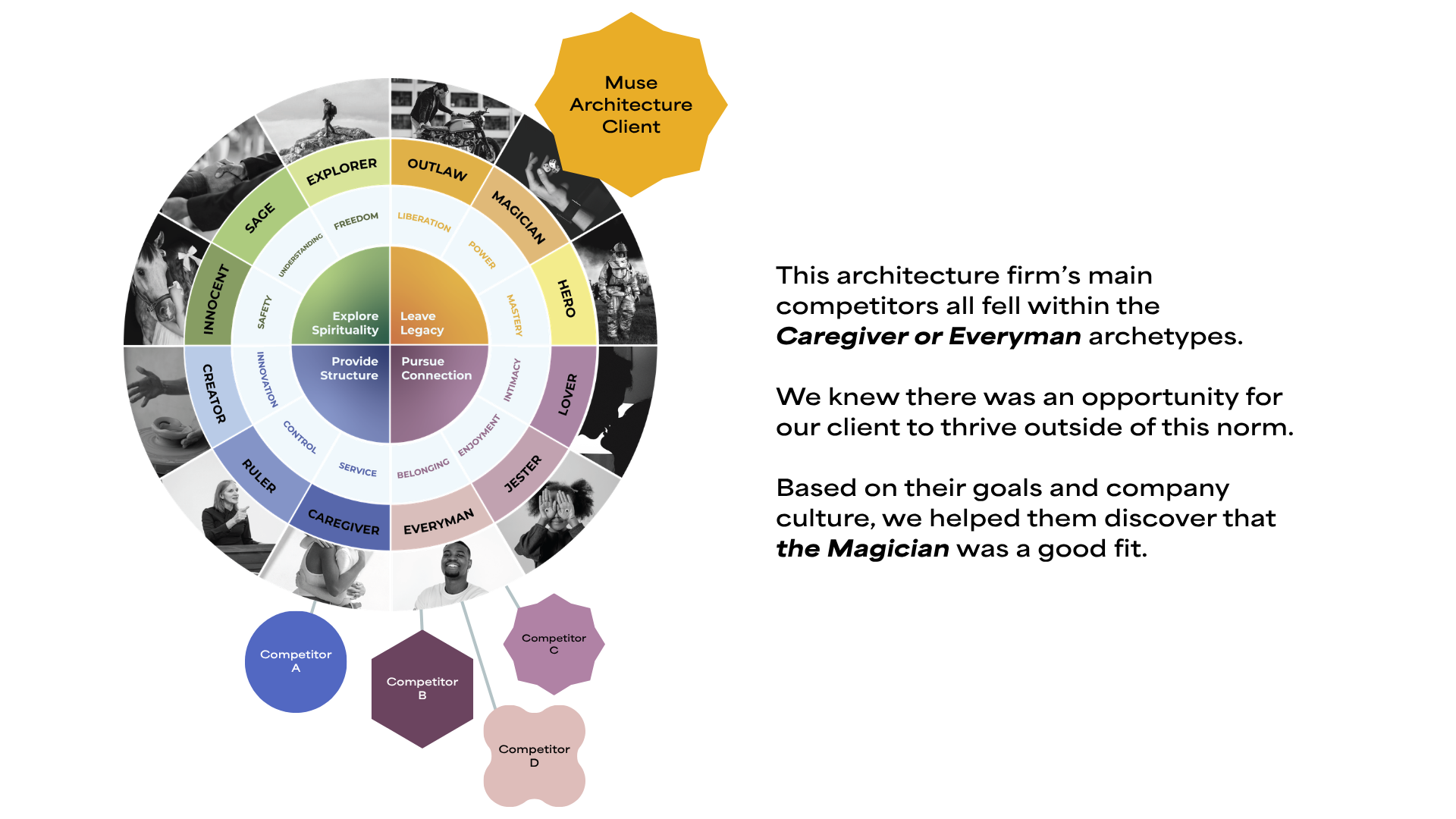
There's also a competitive mapping dimension worth taking seriously. When you look at a category through an archetype lens, strategic white space becomes visible in ways that traditional positioning exercises miss. If every competitor in your space projects precision and control—Ruler energy—there may be real and defensible room for a brand that shows up as warmer, bolder, or more transformative.
At Muse, we regularly do competitive archetype mapping with clients, helping them see not just how competitors are positioned, but how they feel and where there's room to stand for something different.
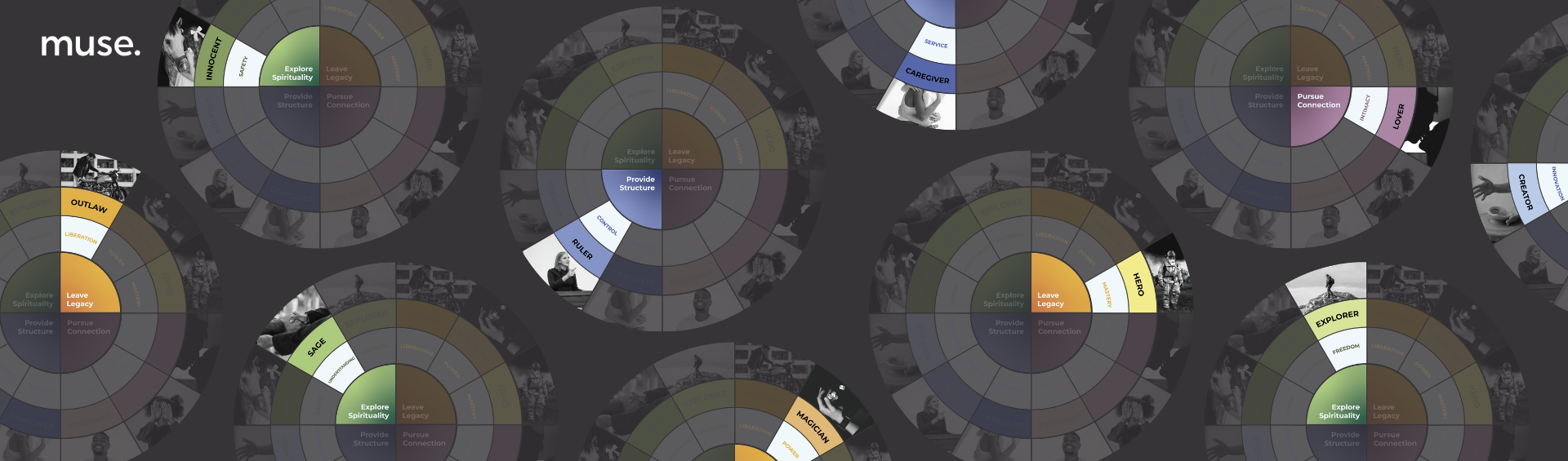
Take one client’s archetype map, for example.
How Archetypes Function Inside the Creative Process
This is where archetypes earn their keep on a day-to-day basis. Once defined, an archetype gives teams of writers, designers, strategists, and content leads a shared framework for evaluating whether their work actually reflects the brand's intended personality. Without that anchor, creative review is just a series of opinions competing to be heard loudest.
Brand Archetypes in Content Marketing.
Explore where strategy meets execution.
More importantly, the archetype changes the nature of creative feedback. Instead of a client saying they just don't love the direction, the conversation shifts to something more principled: is this the choice our archetype would make? This adds a new layer of objectivity. The agency has a clearer brief, and the client has a more thoughtful basis for response. I’d call that a win-win! Most importantly, subjectivity doesn't disappear, but it has somewhere useful to go.
Execution Is Everything
Some archetypes are harder to bring to life than others. It’s something we take seriously because there can be a big gap between naming an archetype and actually executing it.
The Jester is a useful example. Committing to irreverence and humor requires the right creative talent, right leadership disposition, and a genuine organizational willingness to be surprising. A brand can claim a Jester identity and still produce content that feels tentative and beige. I’d consider this worse than having no archetype at all, because it signals a brand that doesn't have the courage of its convictions.
At Muse, we work with one Jester brand in our current client roster. The creative demands are real. It requires a specific type of writer who can operate in that register without tipping into try-hard territory. It also requires leadership who won't flinch when the work is genuinely bold. The archetype only delivers value when the team has both the skill and the organizational courage to follow it through.
How to Identify the Right Brand Archetype
Our process starts with a question that sounds deceptively simple: if your brand were a person, how would you describe them? When we ask leadership teams and staff this question, the answers are revealing. Some brands are service-oriented and connection-driven, while others project reliability and steadiness. The traits that surface—kindness, honesty, bravery, optimism, boldness—often reveal archetypal themes more quickly than a structured exercise does.
But character alone isn't sufficient. The way a business operates matters just as much, and this is a nuance that often gets overlooked. Architecture and engineering firms, for example, operate with precision baked into their DNA because the nature of their work demands it. That operational reality often points naturally toward Ruler or Creator archetypes, where control, process, and consistency are inherent to how work gets done.
By contrast, businesses pursuing disruption or transformation may find the Magician a more honest fit. These are brands where the goal is to take something ordinary and make it remarkable, and where legacy and lasting impact are built into the mission. The archetype should reflect both who the brand is and how the organization actually behaves, not just the identity leadership aspires to project. Aspirational archetypes that don't match operational reality tend to ring hollow quickly.
Archetypes as Inputs for AI-Generated Content
This is where archetypes have taken on significant new practical relevance and where the most forward-thinking marketing teams are already pulling ahead.
Before AI entered the content workflow, translating an archetype into consistent voice and tone was something that only senior-level writers could reliably execute. They had the craft and the instincts to modulate their style to match a brand's personality. Now, AI tools make that capability accessible at scale but only if the archetype is provided as a clear input.
Rather than treating an archetype as something that lives in a strategy deck, teams can feed it directly into tools as a working prompt parameter. The output isn't a finished product, but it gives the AI a personality framework to work against rather than defaulting to generic competence, which is the AI equivalent of brand parity.
Make the Most of the Framework
There's one more consideration that rarely gets enough airtime: archetypes only work if you actually use them.
That sounds obvious, but it's genuinely common for brands to go through the archetype discovery process, arrive at an exciting and honest answer, and then leave it in a strategy presentation that gets opened twice a year. An archetype sitting in a deck is not doing anyone any good.
The most effective use of an archetype is active, not archival. It should be the lens your team reaches for when a creative decision is hard, a piece of content doesn't feel quite right, a new channel is being considered, or a writer is producing work for the first time. The question, “Would our archetype make this choice?” should be as natural and instinctive as any other quality check in your workflow.
The Bottom Line on Brand Archetypes
Strong brands feel familiar on purpose. That familiarity is the result of consistent creative decisions made against a clear sense of the brand personality. Archetypes provide that clarity. They reduce subjectivity, sharpen differentiation, shape content strategy, and now serve as one of the most practical frameworks for directing AI at scale.
For any senior marketer looking for a tool that functions as well in the creative process as in a strategy presentation, archetypes remain one of the most durable frameworks available. They reflect something real about how humans recognize, trust, and choose the brands they keep coming back to.
If your team is interested in foundational brand work like archetype development, schedule time to talk with a Muse brand strategist!
About the Author

Jackie Bebenroth
Jackie Bebenroth is Founder and Chief Brand Advisor of Muse. She works alongside leading brands and executives to develop strategic positioning and messaging strategies that set the stage for long-term success. Her work, from local restaurant branding to six-figure global initiatives, has flown her around the country to speak on the art of content marketing. Jackie has earned a number of accolades, most notably a SXSW Interactive finalist award, the American Advertising Federation’s 40 under 40 award and Content Marketing Institute’s Content Marketing Leader of the Year.
More Good Reads