
Turning Our Advice Inward: The Muse Brand Refinement, Part 1
A look inside what happens when a brand strategy firm refines its own identity.

Jackie Bebenroth, Muse Founder & Principal
After fifteen years of helping organizations redefine their brands, we know that the need for a brand refinement can sneak up on a business. It shows up in both a vague feeling of discomfort (I compare it to wearing dated pants that don’t fit) and in the data that shows a once-thriving growth cycle has hit a slow plateau.
We’ve been feeling and seeing these signs for a year or two, so we stepped into 2026 with the goal of applying our own methodology to Muse itself. I knew it wouldn’t be simple, but the journey has been a bit bumpier than expected.
Brand strategy is often presented as a clean, linear exercise when observed from the outside.
Discovery, definition, refinement, deliverable.
But from within, it’s far more layered. It requires constraint, perspective, and a willingness to question decisions, especially those that are made when you’re too close to know any better. I know this because I watch clients navigate it every year. Sitting in that chair myself has deepened my empathy for those decision makers.
This series documents the process as it unfolds.
Repositioning: Applying Restraint to an Inflated Service Set
Over the past five years, demand at Muse expanded steadily across a wider range of services. Clients came to us for brand strategy, then stayed for content development, campaign execution, and a variety of downstream marketing work. We said yes. A lot. And why not? The strategies were sound, the ideas were fun, and the creative got results.
But as we stepped outside our brand strategy wheelhouse, our position became harder to explain. I found myself struggling to articulate, in a single sentence, where Muse was most differentiated. That’s not a comfortable place for a brand strategist to sit. It was obvious (and somewhat embarrassing) that we hadn't been following our own advice.
We built our reputation as the most experienced brand and content marketing firm in the room. But over the last two years, we've fallen into the “murky middle” of our industry. Our close rate dwindled. Prospects selected one of two groups: full-service agencies, generalists who kept everything, including media, under one roof, or agile specialists who could apply expertise with ninja-like precision.
As we tell our clients, the answer to that challenge is not to get bigger, it’s to get more clarity on our zone of genius. We slimmed down and have become more selective about clients as we recalibrate.
The work Muse does best sits upstream of campaigns and content. As AI continues to reshape execution, strategic thinking becomes more valuable, not less. Perspective, judgment, the ability to synthesize complexity. That's where our people and processes thrive, and that’s where we bring our best and highest value to clients.
The refinement, then, is a return to focus. While we currently market creative, communication, and content services, business brand strategy and personal branding are the core of our business. We’ll always serve in some semblance of storytelling capacity, but activation is a supporting capability, never the starting point.
Visual Identity: Skipping an Overhaul in Favor of a Glow Up
One of the most common things I tell clients is that meaningful change does not require a complete overhaul. We're holding ourselves to that standard.
Our name stays. The logo stays. Much of the color palette carries forward. The work is focused on the system surrounding those assets, the visual language, tone, hierarchy, and composition that have drifted from our underlying strategy as new use cases accumulated over the years. The goal is to bring them back into alignment with an accurate brand archetype and a more precise expression of our position.
I deliberately chose to bring in an external art director before I brought in my own team.
That decision came from experience. In the early years of Muse, I made the mistake of opening the process too wide, too soon. I wanted to be collaborative. The team was relatively new, and we hadn't yet developed the kind of creative trust that makes group input generative. The result was disconnected. Good ideas pulling in different directions.
I've learned from working with dozens of client teams that leaders must be thoughtful with who they bring in at what point of the process. So, this time, I gave our origin story and my vision to one person first. Just one. Molly Russell, an art director across the country, with no prior exposure to Muse and no investment in how we'd done things before.
She came in fresh, which was the point.
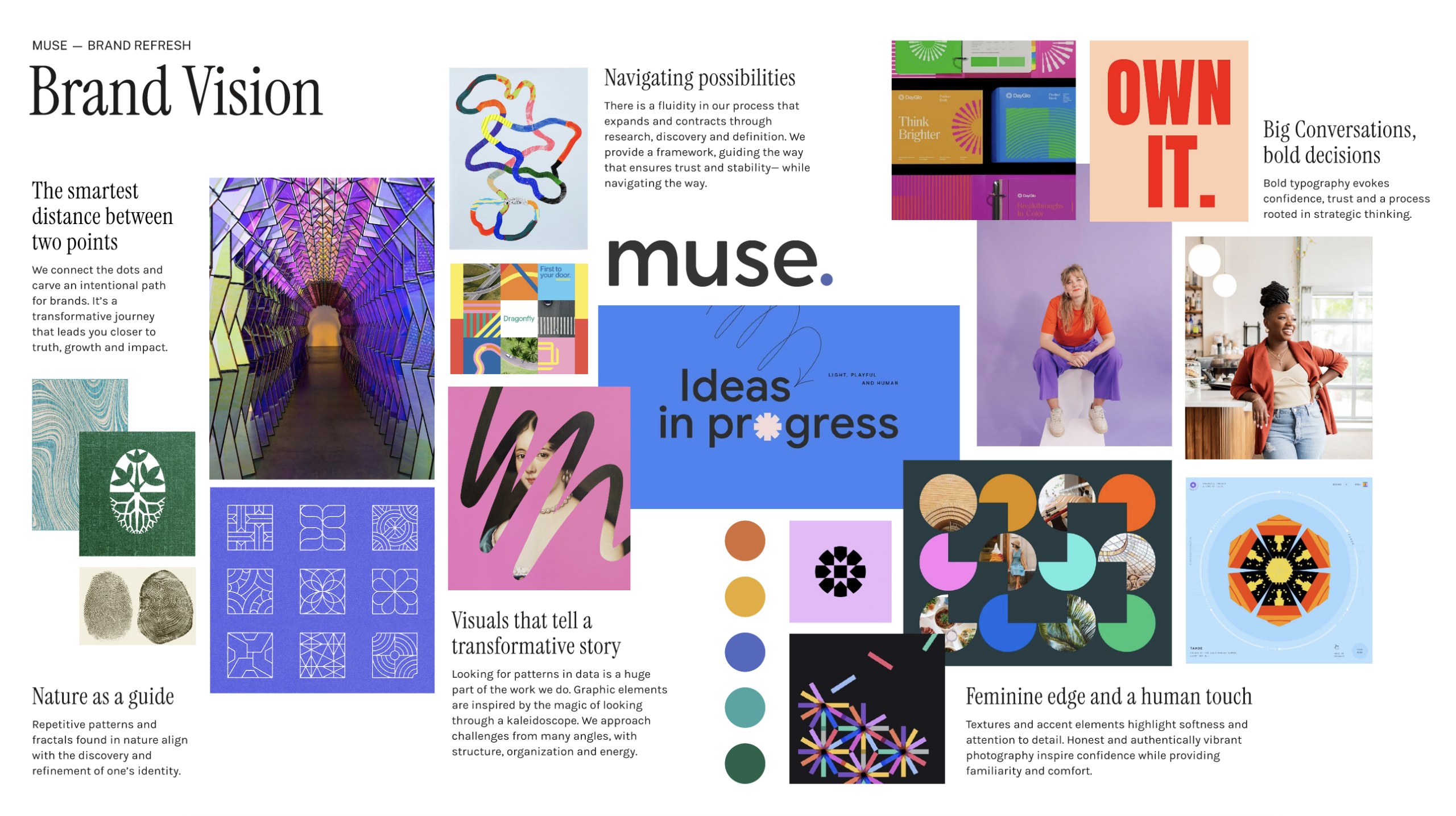
What I notice most is what's gone. We've moved away from nature imagery and topographical maps, visual language that made sense when Muse operated more as a guide archetype, helping clients navigate, orient, and find their way. That framing served us once, but it no longer fits.
What's taken its place is more dynamic. Kaleidoscopic patterns. Refractive geometry. Bold typography that lands with confidence. Vibrant color alongside softer textures and candid portraiture. At the center of the board, three words: "Ideas in progress.” The archetypal shift is real. Muse has become, in practice, a Creator archetype. We help clients imagine what doesn't yet exist, then build it. This mood board, for the first time, shows that.
Muse Team Feedback
I shared the board with the team, hoping for enthusiasm. I got that, along with a sharp eye for how the brand will flex across real-world systems.
A few themes surfaced across their feedback. The kaleidoscope direction resonated strongly as the brand’s visual center. There were honest questions about longevity, specifically whether some of the palette and typographic choices lean too much toward trends to hold up over five or more years. The team flagged a practical tension: a massive amount of the work we produce, outside our website, is built in Canva. Everything from social posts to branded presentation templates and client-facing deliverables. Any system we develop needs to translate into that environment, or it won't survive contact with our actual workflow.
Photography is another open question. The mood board is image-heavy, and we don't have the library to support that approach in the long term. The question is whether the system can carry visual dynamism without relying on it.
What Comes Next
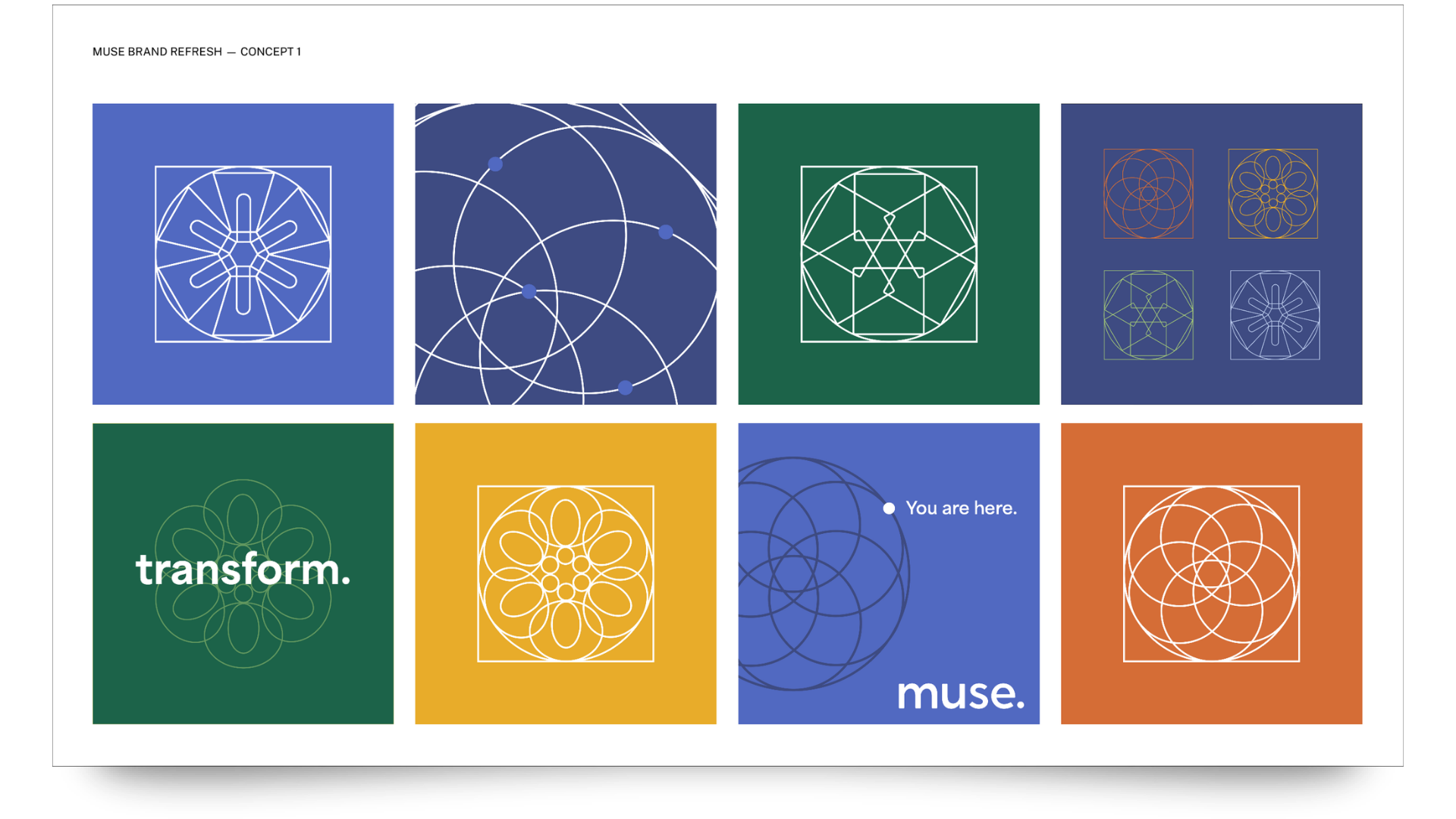
This phase is the beginning of a larger effort to align our positioning, messaging, and visual identity with a more focused direction. The next installment will examine how the themes in the mood board begin to translate into concrete design concepts across key touchpoints. Over time, the series will track how the messaging platform evolves alongside the visual work and what that means for the website.
For now, the question driving everything is simple: what does it look like when a brand finally says exactly what it means? The answer has been a game changer for our clients, and I’m excited to experience it for Muse later this year.
About the Author

Jackie Bebenroth
Jackie Bebenroth is Founder and Chief Brand Advisor of Muse. She works alongside leading brands and executives to develop strategic positioning and messaging strategies that set the stage for long-term success. Her work, from local restaurant branding to six-figure global initiatives, has flown her around the country to speak on the art of content marketing. Jackie has earned a number of accolades, most notably a SXSW Interactive finalist award, the American Advertising Federation’s 40 under 40 award and Content Marketing Institute’s Content Marketing Leader of the Year.
More Good Reads
Why a Brand Redesign May Not Solve Your Brand Strategy Problem
A new logo doesn’t fix an unclear strategy. Muse and Fizz Creative discuss how brand strategy supports meaningful visual branding.
Brand Archetypes Explained: How Personality Drives Differentiation
Personality drives differentiation, and brand archetypes drive personality. Learn what a brand archetype is and why it’s an essential brand asset.